Building resilience through Plan Vivo projects

High integrity in the carbon space today goes beyond robust science. It reflects a broader shift among corporates, from focusing purely on carbon accounting to evaluating how projects strengthen the resilience of ecosystems, carbon outcomes, and local communities.
Carbon credits linked to vulnerable landscapes or communities carry growing risks, particularly in the face of intensifying climate stress, whether in terms of permanence, reliability of delivery, or broader reputational exposure. As a result, leading companies are beginning to look beyond “tonnes of carbon” and ask a fundamental question: does this investment strengthen resilience on the ground?
That is why, ten years ago, we chose to certify our projects beneath the Plan Vivo Standard. For more than 25 years, Plan Vivo has championed the co‑design of nature‑based projects with local communities, protecting vital ecosystems while strengthening local livelihoods. Central to this approach is a strict benefit‑sharing mechanism, with at least 60% of revenues flowing directly to the people managing the land and delivering the impact.
What keeps Plan Vivo at the forefront of the Voluntary Carbon Market (VCM) is not only this consistency, but its commitment to continuous improvement. Today, it stands as a global benchmark for community‑driven land‑use projects, combining a strong social foundation with robust, conservative carbon accounting.
As part of its quality improvements, Plan Vivo launched a Resilience Case Study to better understand how projects strengthen the resilience of climate-vulnerable communities and ecosystems facing interconnected shocks such as drought, conflict, disease outbreaks, and economic instability.

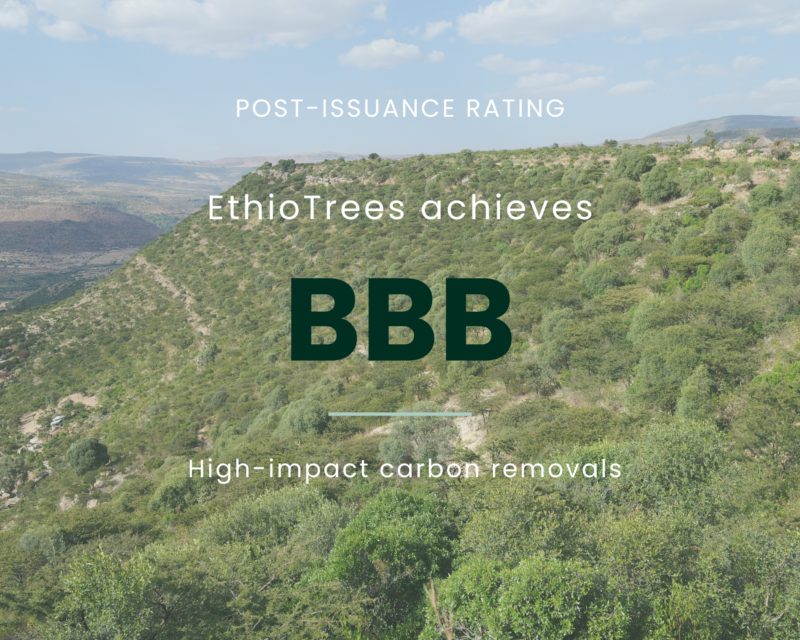
One of the cases studied was our EthioTrees project, which restores degraded landscapes and creates sustainable livelihoods in the northern Ethiopian Highlands. Working with smallholders and landless farmers, the project delivers impact through reforestation, agroforestry, and ecosystem services development. To assess its contribution to community resilience, a case study was conducted in the community of Adi Lethsi, supported by Adrine Kirabo, Regional Project Officer for East Africa under the Plan Vivo Climate Standard.
During her field visit in December 2025, Adrine observed severe water shortages driven by unpredictable rainfall and increased pressure on local resources. She explains: “I could see that the project responded in a positive way. They’ve constructed what they’re calling ponds, that hold water that take the community for close to four months after the rain, which in the past was not there.”

Community members described how periods of extreme water scarcity have shortened significantly, reducing the need for journeys of up to six hours to fetch water. Previously, the water‑shortage period typically lasted from September through June, but today it usually begins only in January, easing pressure on households for several months. As a result, livelihoods have improved. Adrine explains, “They have more time on their farm, so they’re putting most of their time to taking care of the agricultural crops, and this has increased production generally. They’ve had more cattle now and more goats because water is closer to them.”
This is one clear example of how climate finance, when directed to high‑integrity, community‑led projects, can create both environmental and social value. As Adrine describes, “I was able to see it for myself that the projects can improve the community’s resilience to different shocks.”
We strongly believe in this model and in the growing importance of resilience as a defining measure of quality in the Voluntary Carbon Market. For corporates, this shift is not just about impact, but about future‑proofing investments by supporting projects that continue to deliver climate benefits in an uncertain and rapidly changing world.
Subscribe to our newsletter
Join our journey by subscribing to our stories.
Related stories
These are our stories